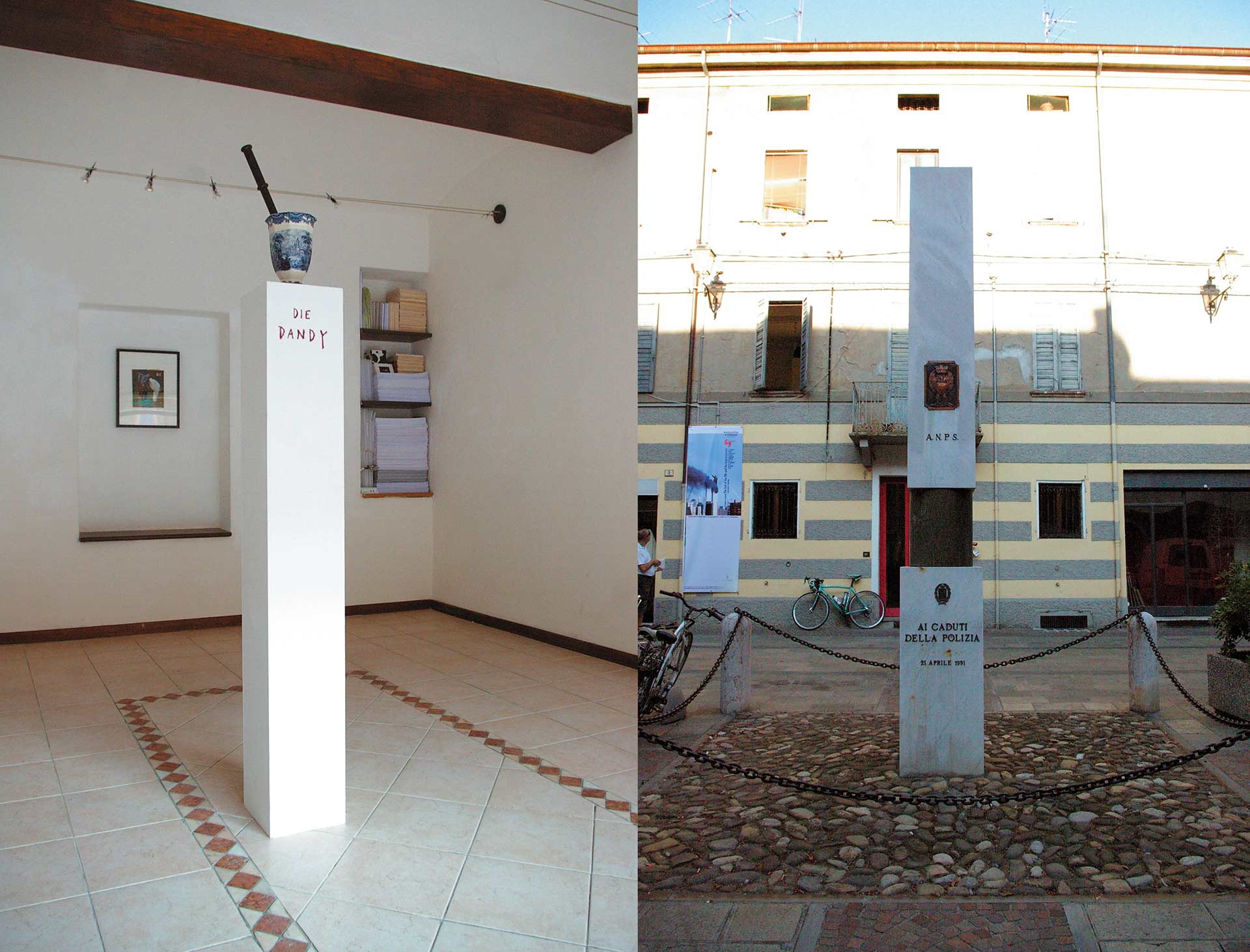
US1006 (Die Dandy), 2010, Porcelain, wood, police baton, lipstick (installed near a monument to the fallenpolicemen in Sassuolo, Italy), variable dimensions.
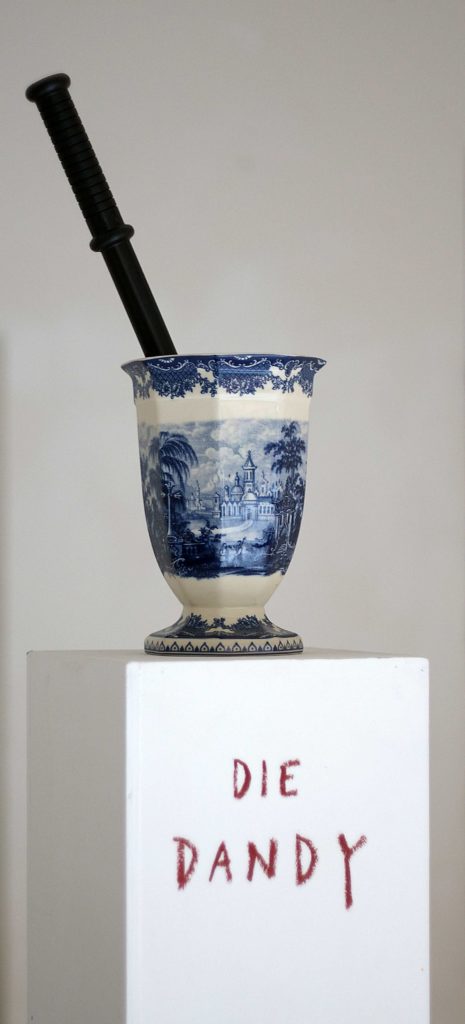
On display in Sassuolo, the centerpiece of the exhibition is a striking installation composed of a refined and delicate vase in an oriental style, containing within it a police baton, a stark symbol of brutality and violence. The whole composition rests on a kind of white memorial column, pure and clean, inscribed with the red text DIE DANDY, evoking the color of blood.
The work is a powerful tribute to Oscar Wilde, who was beaten by police upon his arrest due to his homosexuality. That beating would later result in an infection, ultimately leading to his death.
From the outset, we are confronted with sharp contrasts: the delicacy of the vase, an object that Wilde himself, in his writings, described as symbolic of his very purpose in life, and the column, stand in opposition to the violent presence of the baton and the harshness of the text.
Life and death blend seamlessly here in a single work that serves not only as a memorial, but also as a form of protest.
Read together in Italian, the two plinth, DIE and DAND, form a monument that contains both sides of humanity: from the dandy to those fallen at the hands of the police.
In mostra a Sassuolo l’opera protagonista è composta da un vaso dallo stile orientale, raffinato e delicato, che contiene al suo interno un manganello della polizia, simbolo di brutalità e violenza, il tutto è poggiato su una sorta di colonna memoriale bianca, candida, dove si erge la scritta DIE DANDY, rossa, quasi a richiamare il colore del sangue.
Un forte tributo ad Oscar Wilde, picchiato dalla polizia quando fu arrestato a causa della sua omosessualità. Il pestaggio gli provocherà successivamente un’infezione, che ne causerà la morte.
Vediamo da subito come questa sia un’opera piena di contrasti tra la delicatezza del vaso, che lo stesso Oscar Wilde, in uno dei suoi scritti, individua come la sua ragione di vita, e della colonna e la brutalità del manganello e della scritta.
Vita e morte qui si mescolano perfettamente in un’unica opera non solo memoriale ma anche di denuncia. Leggendo all’italiana i due plinti insieme, il monumento diventa uno e contiene le due facce dell’umanità: dai dandy ai caduti della polizia.